

The Mark
The illusion of control and the unbridgeable void behind our smallest habits.

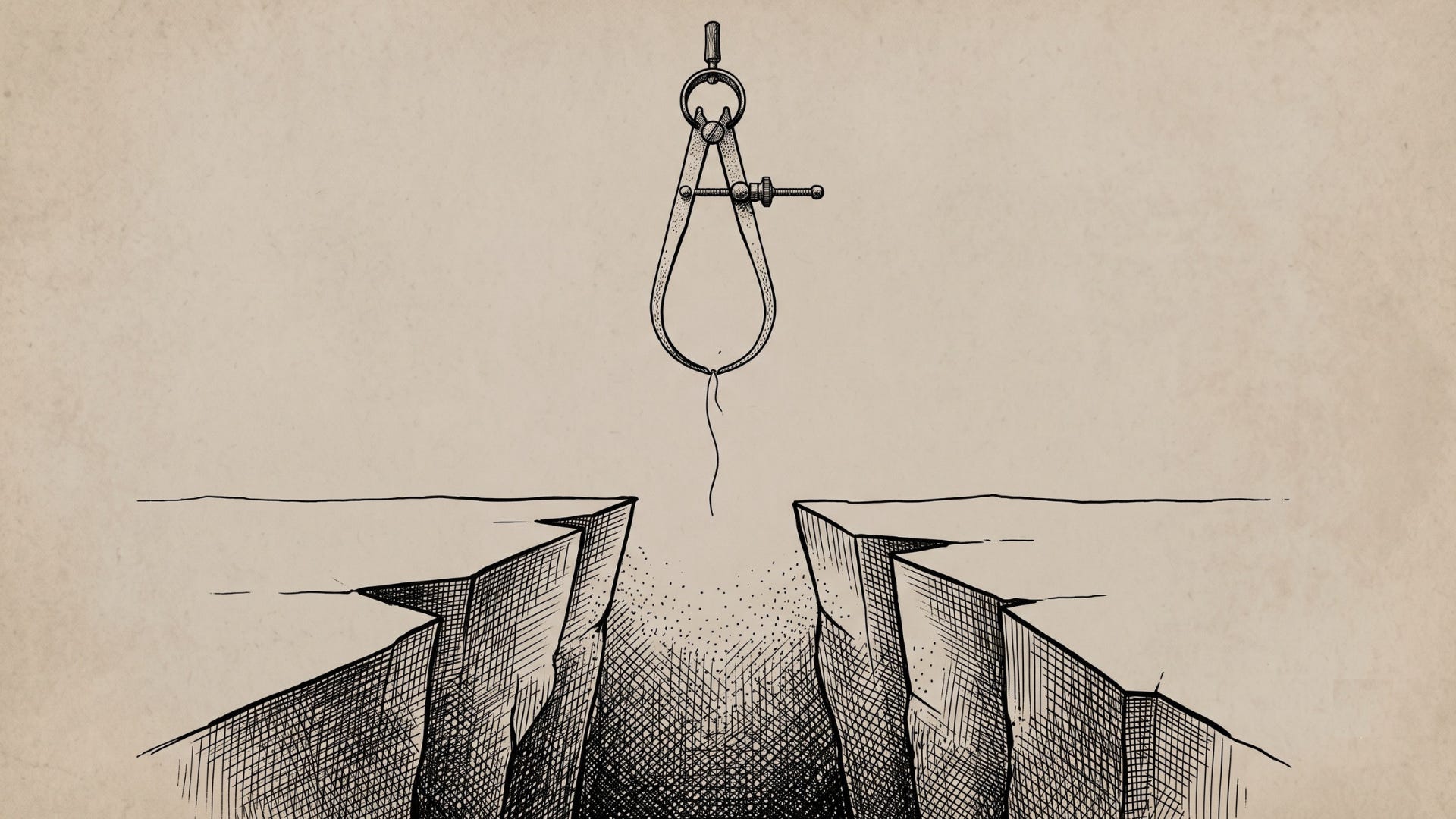
Ellen - not her real name, and I have altered enough details to protect her identity - visited my practice as a patient every Tuesday at 6 p.m., always arriving ten minutes early. Upon entering the room, she would take her usual spot on the sofa and, almost imperceptibly, use her left hand to obscure a small mark on her chin.
I waited months before asking about it.
When I finally did, she told me it was a habit she had formed at the age of fourteen. First using only her hand, later relying on makeup, and eventually employing both. She didn’t consider it significant. To her, it was simply something she did, much like locking her door at night.
What initially drew my attention, however, was not the mark itself, but the precision and economy of the movement with which she touched it. It had become so automatic, so deeply unconscious, that it required absolutely no cognitive effort. The fascinating - and potentially unsettling - aspect was not that she was hiding something, but that she had forgotten she was hiding anything at all.
Donald Winnicott, a pediatrician before he became a psychoanalyst, spent decades observing infants and their mothers. He arrived at a distinction that seems deceptively simple until you try to live it: There is a true self, born of spontaneous gesture, and a false self, constructed in response to the environment’s expectations. The false self, he wrote, is not a fraud. It is a sentinel. It protects something far too vulnerable to be exposed to a world that offers no guarantees of holding it gently.
This, incidentally, is also the role of the “good-enough” mother: To be sufficiently attuned to tolerate and welcome that spontaneous gesture, allowing the false self to safely integrate with the true self.
The inherent problem with the false self - this vigilant sentinel - is that, over time, it forgets what it is guarding and focuses solely on the act of guarding. Out of habit. Out of necessity. Because it is the only way it knows how to operate.
Yet, Ellen had not entirely forgotten.
I believe that is why she kept showing up every Tuesday. Somewhere deep within her, something was still knocking at the door, and it wasn’t the mark on her chin. It was something far more difficult to name. She once told me about the moment she closed her front door at night, remarking that, for a split second, nobody knew where she truly was. Not physically. Truly. She noted how alone she felt, and how alone she was, carrying both the comfort and the terror of that reality.
Irvin Yalom gives a name to this fleeting second. He calls it existential isolation, describing the unbridgeable gulf between our inner world and every other inner world, regardless of how close another person stands. This is not social loneliness. You can experience this isolation while surrounded by people who genuinely love you. Perhaps it is felt even more acutely then, because their love highlights exactly how close they can get, and how, despite that proximity, they can never truly enter.
Ellen, like most of us, had made a fundamental error in translation early in life. She had taken this void - a baseline condition of the human experience - and interpreted it as a personal failure. Her psyche, attempting to organize the chaos as best it could, assigned the blame to the mark on her chin. And so, she began trying to fix her chin, hoping to close a chasm that no correction can ever bridge, and for which no physical imperfection is responsible.
The pain of what I cannot yet achieve is always lesser than the profound frustration caused by what I will never be able to achieve. The former pushes us toward accomplishment and action, granting an illusion of control; the latter calls upon us to mourn and, ultimately, to mature.
Ellen needed to mourn. She had to grieve the comforting fantasy that, if only her chin were flawless, that chilling moment of existential isolation behind a closed door would vanish along with the blemish. Therapy was not about teaching her to love her mark. It was about helping her accept the void her hand was so desperately trying to cover.
I recall a period of about six months during which she did not touch the mark in our sessions. I did not view this as a “completed treatment.” I saw it simply as a moment where her hand hesitated in mid-air, because the old, tireless sentinel had begun to realize that the castle it was guarding was no longer in danger of falling.
There is no cinematic triumph here. There is no final scene where someone throws away their makeup and walks, redeemed, into the light. There is only another Tuesday, at ten minutes to six, with a hand suspended somewhere between a safe, familiar habit and something entirely new that does not yet possess a name.
And perhaps, in the end, healing and therapy are not found in the permanent dismissal of the guard. Perhaps they reside merely in this brief pause… In that fraction of a second where, just for a moment, you can bear to look into the void without rushing to cover it up.
.
.
Until next time,
K.
For twenty years I have watched intelligent people understand everything and change almost nothing. Understanding alone is not enough. It needs something that forces you to look directly at what you already know is there.
That is why I built The Black Box: A 30-day protocol for radical truth. One question per day. No exits.